SCO: Consensus Crumbles Again
“India Isolated as Pakistan and China Push Back at SCO Meeting”
Abobakar Khan
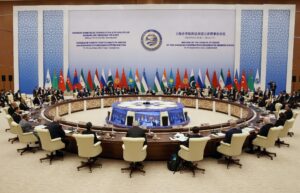
The highly anticipated Shanghai Cooperation Organisation (SCO) defence ministers’ meeting in Qingdao, China, aimed to project unity and collective resolve among its ten-member states. Instead, it concluded without the customary joint communique, revealing cracks within this carefully curated Eurasian bloc—most prominently the widening fissure between India and Pakistan.
Unlike previous summits, Thursday’s meeting failed to yield a consolidated communiqué, marking a rare breakdown in the SCO’s consensus-driven decision-making model. The impasse revolved around a seemingly technical yet politically charged omission, the exclusion of any reference to the April 22 Pahalgam terror attack in Indian-administered Kashmir, which claimed 26 lives. India asserted that the attack was claimed by The Resistance Front (TRF), a proxy of Lashkar-e-Taiba, and demanded its inclusion. However, Pakistan and China resisted, prompting India to “walk away” from the joint statement rather than endorse what it viewed as a deliberate snub.
In Randhir Jaiswal’s (spokesperson for India’s Ministry of External Affairs) words, “India wanted concerns on terrorism reflected in the document, which was not acceptable to one particular country. As such, the joint statement was not adopted”.
While the Defence Minister Rajnath Singh took a firm stance, citing the Pahalgam attack in a powerful address, warning against cross-border terror networks and state sponsors. He declared, “There should be no place for double standards… some countries use cross-border terrorism as an instrument of policy and provide shelter to terrorists”.
He reiterated that international peace could not coexist with terrorism and proliferation of weapons in the hands of non-state actors, urging SCO nations to unite in accountability. His refusal to sign the communique echoed a broader message, India will no longer acquiesce when pivotal security concerns are sidelined.
Moreover, he announced India’s right to self-defence, citing “Operation Sindoor”, a cross-border operation launched in response to the terror attack.
Pakistan’s Counter-Narrative
For Islamabad, the meeting was a diplomatic victory. Officials, speaking anonymously, claimed India found itself diplomatically isolated and failed to gather support among SCO members on the Kashmir issue.
“India failed to link the Pahalgam incident to Pakistan … stood alone in its differing stance on Israeli aggression against Iran,” said a Pakistani insider.
Defence Minister Khawaja Muhammad Asif used the platform to reaffirm Pakistan’s stance on terrorism, condemning violence “in all forms” and asserting Islamabad’s commitment to regional stability. He also denounced Israeli airstrikes on Iran and placed the blame on unnamed “state actions” behind the Balochistan unrest.
On broader terms, Asif praised China as a “friend and brother” and supported the SCO’s role in safeguarding justice and security.
China’s Diplomatic Tightrope
As host and chair, China found itself navigating competing pressures. Despite initial attempts to downplay the rupture—highlighting successful cooperation on multiple fronts—Chinese Defence Minister Dong Jun issued a statement affirming China’s commitment to “Shanghai Spirit” and promising steady defence collaboration.
However, China’s aligning with Pakistan in resisting India’s demands indicated its preference for a softer stance, seeking to preserve ties with both India and Pakistan while minimizing discord within the SCO’s structure.
India-China Bilateral Dynamics
Amid the discord, India-China relations showed signs of cautious thaw. Defence Ministers Rajnath Singh and Dong Jun held their first in-person meeting since the 2020 Galwan Valley clashes, signalling limited restoration of communication channels. Singh emphasized the need for a “permanent solution to the border dispute,” marking a shift from India’s prior emphasis on temporary de-escalation.
This careful engagement reflects India’s larger strategic calculus—simultaneously asserting its position at the SCO while proactively engaging China to manage bilateral tensions.
Ripple Effects Across the Regional Security Terrain
- Multilateral Cleavages Within SCO
The collapse of the joint statement exposes deeper fissures in the bloc’s cohesion. Previously, SCO’s National Security Advisers reportedly drafted a balanced draft addressing both India and Pakistan’s concerns during closed-door discussions. The breakdown at the ministerial level marks a significant setback for SCO’s internal consensus mechanisms, raising questions about its functional viability when core members clash.
- New Delhi’s Strategic Posture
India’s defiance signals a growing reluctance to conform in forums perceived as favoring China. Having earlier rejected an SCO declaration condemning Israeli strikes on Iran, India has repositioned itself as a strategic actor unwilling to compromise core national interests. This stance, however, entails costs: repeated non-cooperation risks marginalizing India within the organisation and reducing its diplomatic capital in Eurasian multilateralism.
- Sino-Pakistani Consolidation
Conversely, Pakistan appears to have strengthened its partnership with China within the SCO framework. Asif’s praise and public alignments reinforce a narrative of Islamabad’s strategic dependency on Beijing, signaling enhanced intelligence-sharing and military collaboration.
- Moscow under Pressure
Russia also faces the challenge of maintaining its influence within the SCO while accommodating India and Pakistan. Already engrossed in the Ukraine conflict, Russia depends on multilateral platforms like SCO for legitimacy. But deeper India–Pakistan discord undermines Moscow’s aim to present the bloc as a cohesive counterweight to Western influence.
Geopolitical Stakes Ahead
a. SCO’s Coherence in Question
With irreconcilable differences among its core members, SCO’s credibility as a vehicle for regional security cooperation is under scrutiny. If consensus falters at the defense-minister level, outcomes at the Heads-of-State summit this autumn may be similarly compromised.
b. India’s Global Repositioning
India is emerging as a selective multilateralist—simultaneously engaging China and redefining its role from Central Asia to the Indo-Pacific. Its refusal to rubber-stamp positions incongruent with its interests suggests a broader recalibration of strategic alliances, including stronger alignment with Western partners
c. Pakistan’s Strategic Alignment
By aligning closely with China and pushing back against Indian pressures within the SCO, Pakistan appears to be doubling down on its pivot eastward, strengthening intelligence cooperation and military ties with Beijing while deepening its critique of India’s regional policies.
d. China’s Balancing Act
China must maintain a delicate theatrical balance—appearing the impartial chair yet underpinning Pakistan’s positioning. A persistent India–Pakistan discord within SCO risks tarnishing China’s ambition to present the bloc as a model for multipolar regional order.
Thursday’s SCO defence ministers’ meeting ended not with a joint communiqué but with a stark showcase of regional fractures. India’s withdrawal from consensus over the Pahalgam terror omission, Pakistan’s diplomatic triumph, and China’s tightrope positioning brought to light the fragile mechanics underlying this Eurasian bloc. As SCO prepares for its leaders’ conclave, these simmering contradictions will shape not just the summit agenda—but the future of multilateral diplomacy in an increasingly contested and interconnected world.