Forging the Future: Poland Rolled Out the Red Carpet for Asante King
Byline: Dela Ahiawor
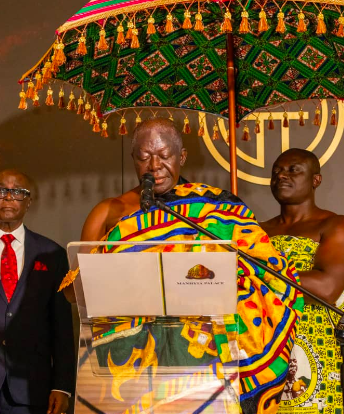
On May 30, 2026, under the chandeliers of Warsaw’s Royal Łazienki Museum, a 16th-century Asante gold sword rested beside a crystal gavel. The scene was not historical reenactment but diplomatic invention. His Majesty Otumfuo Osei Tutu II, the 16th Asantehene of the Asante Kingdom, had been invited to Poland not as a tourist attraction but as architect of a new Europe-Africa compact. For five days in May, Poland treated an African king with the protocol of a head of state: meetings with deputy ministers, keynote addresses at the Foksal Palace, and a gala that raised €20 million for Ghanaian philanthropy.
The visit, orchestrated by Polish-Ghanaian philanthropist and Asante royal descendant Omenaa Mensah and her husband Rafał Brzoska, was billed as the TOP CHARITY ChangeMAKERS 2026 forum and Gala. But it was more than charity. It was a geopolitical statement: that the future of Europe-Africa relations will be forged not only in Brussels and Addis Ababa, but in palace halls, boardrooms, and cultural spaces where tradition meets capital, and where a king who “thinks about the next generation” negotiates with a Europe that “thinks about elections.”
This feature goes beyond the event report. It analyzes what the Asante King’s Warsaw visit reveals about three fault lines in contemporary diplomacy: the rise of traditional authority as soft power, the redefinition of philanthropy as geopolitical infrastructure, and the search for a Europe-Africa partnership beyond aid. Using the Otumfuo’s May 2026 visit as a case study, it argues that Poland’s red carpet was not just courtesy to a king. It was Poland positioning itself in Africa’s century.
Part I: The Monarch as Diplomat — Traditional Authority in a Post-Westphalian World
The Asante Kingdom is not a museum piece. It is a 300-year-old political entity with a complex bureaucracy, a gold-based cultural economy, and jurisdiction over land and chieftaincy disputes in modern Ghana. Otumfuo Osei Tutu II reigns without executive power over Ghana’s state, but with moral authority over 9 million Asante people and influence across West Africa.
His Warsaw visit demonstrates a global trend: the resurgence of traditional authority in international relations. In a Westphalian system that recognizes only nation-states, kings, queens, and chiefs were relegated to “culture.” That is changing. Three forces explain why.
1. Legitimacy beyond elections
Otumfuo told the ChangeMAKERS forum: “Politicians tend to think about elections, my focus is firmly fixed on creating sustainable value for the next generation.” The line was not rhetoric. In Ghana, where electoral cycles are 4 years, traditional leaders operate on generational time. They manage stool lands, adjudicate disputes, and fund schools and clinics through endowments. For European partners frustrated by policy whiplash after elections, traditional leaders offer continuity. Poland’s Undersecretary of State Wojciech Zajączkowski recognized this when he stressed Ghana’s role as a “stable and democratic economic partner.” Stability is not just institutions; it is also symbols that outlast governments.
2. Cultural capital as economic capital
The Asantehene did not come to Warsaw empty-handed. He brought what Joseph Nye would call “soft power”: the ability to attract rather than coerce. Asante gold, kente, proverbs, and governance philosophy were displayed at the Royal Łazienki Museum. In an age where European audiences are saturated with African poverty narratives, the display of a living, sophisticated monarchy disrupts stereotypes. That disruption has economic value. Investors who see cultural depth are more likely to see long-term opportunity. The Gala’s €20 million fundraising was not just generosity; it was investment triggered by cultural confidence.
3. Diaspora as bridge
Omenaa Mensah, the Polish-Ghanaian philanthropist who invited the King, embodies a new diplomatic actor: the diaspora royal. She is Asante by descent, Polish by citizenship, and global by network. Diaspora actors translate between systems. They explain to Polish business why stool land tenure matters; they explain to Asante elders why Polish ESG standards matter. Without Omenaa Mensah, the red carpet would not exist. The future of Europe-Africa diplomacy will be written by such translators.
The risk is romanticization. Traditional authority can also entrench patriarchy, land inequality, and opaque governance. The analytical question is not whether kings are good, but how their legitimacy can be channeled into development without eroding democratic accountability. Otumfuo’s emphasis on “sustainable value for the next generation” suggests he is aware of the tightrope.
Part II: Philanthropy as Geopolitical Infrastructure
The TOP CHARITY GALA raised approximately €20 million for Ghana. In development terms, €20 million is modest compared to EU aid budgets. In geopolitical terms, it is revolutionary. Why?
From aid to architecture
Traditional aid flows from state to state, often with conditionalities and bureaucratic lag. The TOP CHARITY model is different: private capital, cultural framing, and immediate deployment. Rafał Brzoska, founder of InPost, and Omenaa Mensah used their business and cultural networks to mobilize Polish and global business leaders in one night. The Gala was not a handout; it was an architecture for direct investment in Ghanaian education, health, and entrepreneurship.
This matters because Africa’s demographic reality demands new financing models. Africa has 1.49 billion people, average age 19.7, 600 million internet users, and AfCFTA covering 54 countries. Sub-Saharan Africa accounts for 70% of global mobile money transaction volume, $832 billion annually. The continent does not need charity. It needs capital that understands its speed. Philanthropic capital, when deployed like venture capital, can move faster than state aid.
Philanthropy as trust-building
The Gala’s location in the Royal Łazienki Museum was symbolic. Poland was saying: we trust African leadership enough to host it in our royal space. The Asantehene’s praise for the Brzoska-Mensah duo was reciprocity. Trust is the missing infrastructure in Europe-Africa relations. Europeans fear corruption; Africans fear extraction. Philanthropy, when transparent and co-designed, builds trust faster than trade agreements.
The ChangeMAKERS thesis
The forum’s theme, “The Age of Reimagination. Art, Business and Philanthropy,” was not accidental. It argued that leadership must be redefined beyond GDP to include responsibility, education, culture, and long-term social impact. That is a direct challenge to transactional diplomacy. Poland, still building its post-1989 global identity, used the forum to position itself not as a donor but as a co-creator. Deputy Minister Zajączkowski listed agri-food, machine industry, transportation, digital, and cybersecurity as sectors for cooperation. He was not offering aid; he was offering partnership.
The analytical point: philanthropy is becoming geopolitical infrastructure because states are slow and markets are amoral. Hybrid actors — businesspeople with cultural roots — can fill the gap.
Part III: Poland’s Africa Strategy — From Solidarity to Strategy
Why Poland? Why now?
Poland’s engagement with Africa has deep roots. In 1961, after the Year of Africa, Kwame Nkrumah visited Warsaw. Ghanaian students studied in Poland; Polish engineers worked in Ghana. That was “solidarity diplomacy” rooted in shared post-colonial and post-war experience. The relationship cooled after 1990 as Poland turned West.
The 2026 visit signals a strategic pivot. Three drivers:
1. Economic diversification
Polish companies are saturated in the EU market. Africa is the next growth frontier. Zajączkowski’s list of sectors was precise: agri-food for food security, machines for industrialization, transport for logistics, digital and cybersecurity for the continent’s mobile money boom. Poland has comparative advantage in mid-tech manufacturing and infrastructure. Africa has demand and demographic dividend. The fit is structural, not sentimental.
2. Soft power competition
France, China, Turkey, and Gulf states are already deep in Africa. Poland cannot compete on volume, but it can compete on narrative. By hosting the Asantehene, Poland signals respect for African agency and tradition — a contrast to extractive models. In diplomacy, symbolism matters. A king in Warsaw is a message to other African leaders: Poland sees you as partners, not projects.
3. Diaspora leverage
Omenaa Mensah’s role shows Poland’s untapped asset: its African diaspora. There are an estimated 20,000 Ghanaians in Poland. They are traders, students, professionals. They are bridges. Poland’s Africa strategy will succeed only if it empowers this diaspora as economic and cultural ambassadors, not just migrants.
The risk for Poland is overreach. Hosting a king is easy; sustaining trade missions, legal protections for investors, and cultural literacy is hard. The €20 million is a down payment. The real test is whether Polish SMEs follow Brzoska into Ghanaian agri-tech or cybersecurity.
Part IV: Ghana’s Position — Gateway, Not Just Host
Ghana’s role in this drama is strategic, not passive.
Institutional anchor
Accra hosts the African Continental Free Trade Area Secretariat. That makes Ghana the bureaucratic heart of Africa’s $3.4 trillion single market. For Poland, partnering with Ghana is a shortcut to AfCFTA. It is easier to negotiate standards and logistics in Accra than in 54 capitals.
Political stability as asset
Zajączkowski called Ghana a “stable and democratic economic partner.” In a region facing coups and insurgencies, Ghana’s democratic continuity since 1992 is rare. Stability attracts capital. The Asantehene’s presence amplifies that message: traditional and modern institutions can coexist and reinforce legitimacy.
Cultural entrepreneurship
Ghana has exported culture globally — Afrobeats, film, fashion. The Asantehene’s visit adds “institutional culture” to that export list. A monarchy that runs schools, mediates conflicts, and funds hospitals is a model of hybrid governance. For Europe, it offers a lesson: modernity does not require erasing tradition.
The challenge for Ghana is to convert symbolism into systems. The €20 million must fund projects with measurable impact, not just prestige. And Ghana must ensure that Polish investment does not replicate extractive patterns of earlier European engagement.
Part V: The Analytical Core — What “Reimagination” Really Means
The forum’s theme demands unpacking. “The Age of Reimagination” is not branding. It is a diagnosis of three broken assumptions in Europe-Africa relations.
1. Reimagining power
The old model: Europe has capital and technology; Africa has resources and labor. The new model, hinted at by Otumfuo, is mutual respect. Respect means recognizing African institutions like chieftaincy as governance partners, not anthropological curiosities. It means Europe listening as much as it lectures.
2. Reimagining value
GDP measures transactions, not transformation. The ChangeMAKERS forum elevated education, culture, and long-term impact as metrics. For the Asantehene, value is measured in schools built and disputes resolved, not quarterly returns. For Poland, value may mean diversified markets and cultural influence. Reimagining value requires new scorecards.
3. Reimagining partnership
The 1961 Nkrumah-Warsaw link was state-to-state. The 2026 link is state + monarchy + business + diaspora + civil society. That is messy but more resilient. Partnership in 2026 must be multi-stakeholder, not just intergovernmental.
The presence of UNESCO’s Åsa Regnér, AI expert Clare Maguire, and entrepreneur Martin Vohánka at the forum shows the breadth required. Africa’s future will be shaped by AI, education, and culture as much as by mines and ports. Europe-Africa partnership must therefore be trans-sectoral.
Part VI: Risks and Counter-Narratives
No analytical feature is complete without stress-testing the optimism.
Risk 1: Cultural diplomacy without substance
A gala and speeches can create “photo-op diplomacy” with no follow-through. The €20 million must be audited and tied to outcomes. Otherwise, the Asantehene’s visit becomes a memory, not a mechanism.
Risk 2: Traditional authority vs democracy
Elevating traditional leaders can undermine elected institutions if not managed carefully. Ghana’s constitution balances chieftaincy and democracy. Poland must engage both, not bypass parliament for palace.
Risk 3: Selective sectors
Zajączkowski’s focus on agri-food, machines, digital, and cybersecurity is smart but risks neglecting sectors where Ghana needs jobs most: light manufacturing and services. Partnership must address employment, not just investment.
Risk 4: Diaspora instrumentalization
Diaspora actors like Omenaa Mensah are powerful but can be seen as “neither here nor there” by both sides. Their legitimacy depends on delivery and transparency.
The counter-narrative is that this is elite theatre. Critics will ask: how many rural Ghanaians benefit from a gala in Warsaw? The answer must be concrete: scholarships, clinics, startups funded. Without that, analysis collapses into PR.
Conclusion: The Future Is Forged, Not Found
The Asante King’s Warsaw visit was more than ceremony. It was a prototype for 21st-century diplomacy: traditional authority + private capital + diaspora networks + state partnership, all framed by culture.
Poland rolled out the red carpet not just for Otumfuo Osei Tutu II, but for a model of Europe-Africa relations where respect precedes contracts, culture precedes capital, and the next generation precedes the next election.
The €20 million raised will build schools or clinics. More important, the visit built a template. If Polish companies enter Ghana’s agri-food or cybersecurity sectors with the same respect shown to the Asantehene, then Warsaw becomes a gateway, not just a host. If Ghana leverages AfCFTA and its cultural assets with the discipline Otumfuo preaches, then Accra becomes a partner, not just a recipient.
“Poland gave me education and opportunity, but Africa gave me spirit,” the King said. The future of Europe-Africa relations depends on keeping both: the education and opportunity of Europe, and the spirit and purpose of Africa.
The red carpet has been rolled out. Now the work of forging the future begins.