Italy: Where Poetry Becomes a Homeland
The Literary Journey of Ismael Diadié Haidara
There are journeys measured in kilometers, and others measured in encounters. Ismael Diadié Haidara’s recent voyage through Italy belongs unmistakably to the latter. It was not simply a passage from one city to another, but a pilgrimage through the living geography of poetry, philosophy, and friendship, where every destination carried the memory of a civilization and every conversation became an extension of literature itself.
Naples welcomed him first—not merely as a traveler, but as a fellow guardian of words.
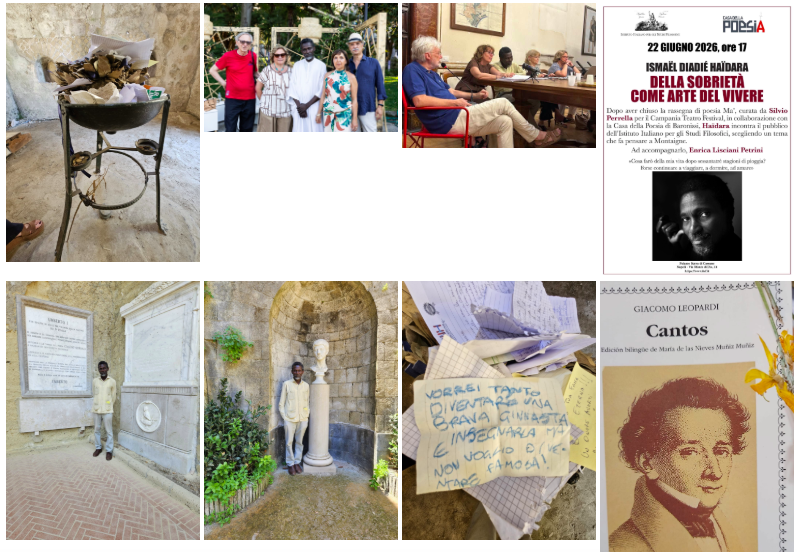
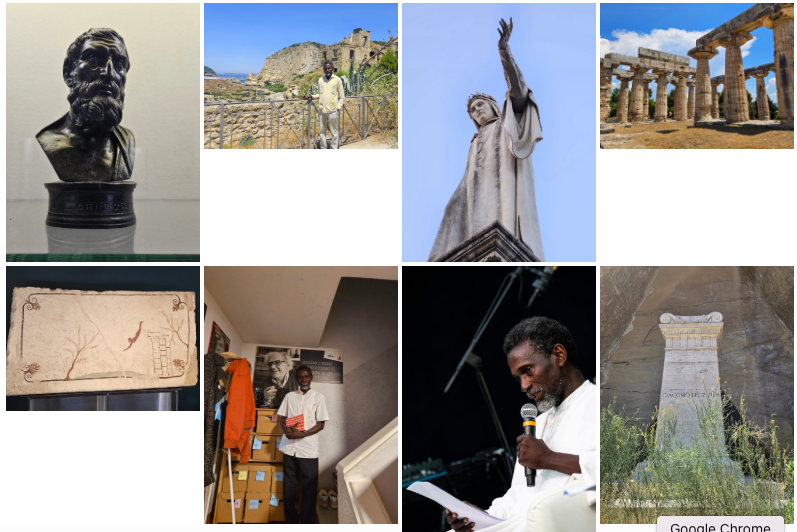
There, at the tomb of Virgil, one of the founding voices of Western poetry, Haidara witnessed a ritual both ancient and surprisingly alive. Visitors climbed the 131 stone steps leading to the poet’s resting place, not as tourists but as believers. Some pilgrims seek miracles at the tombs of saints; here, they entrusted their dreams to a poet. It was, as Haidara quietly observed, one of the beautiful mysteries of Italy—a country where literature is still granted the dignity of faith.
Not far away rested Giacomo Leopardi, another immortal whose poetry transformed solitude into universal music. Standing before his tomb, Haidara found himself within an invisible dialogue stretching across centuries, where poets continue speaking long after history has fallen silent.
And then came Dante.
To stand at the feet of the author of the Divine Comedy in Naples, camera in hand, seemed almost an act of daring. Some monuments demand admiration; Dante demands humility. Yet the photograph became less a souvenir than a declaration of gratitude from one poet to another.
Italy, however, revealed itself not only through its monuments but through its people.
Accompanied by his Italian translators, Giancarlo Cavallo and Rossella Nicolò, and welcomed by his publishers, Raffaella Marzano and Sergio Iagulli, Haidara discovered another homeland—not of birth, but of affection. Friendship became the true language of the journey.
“Sad is the one,” he reflected, “who has no reasons to be grateful.”
Italian became more than a language translated into; it became a language of hospitality. The celebrated Casa della Poesia in Baronissi proved worthy of its name—not merely a House of Poetry, but a house where every poet could feel at home. Under the devoted guidance of Sergio Iagulli, whose work has shaped decades of contemporary Italian poetry, literature became not an institution but a family.
The intellectual heart of the journey unfolded at the Italian Institute for Philosophical Studies, where Haidara delivered his lecture, Della sobrietà come arte del vivere (“Sobriety as the Art of Living”). It was a fitting venue. Hans-Georg Gadamer once praised the Institute as a rare place capable of renewing Europe’s cultural spirit beyond bureaucracy and economic calculation, envisioning instead a civilization founded upon solidarity and peace. Haidara’s own reflections echoed that aspiration, reminding his audience that true wisdom begins not with abundance, but with measure.
His pilgrimage then turned toward one of philosophy’s forgotten sanctuaries.
On the hill of Posillipo, overlooking the Bay of Naples, he visited the ancient Epicurean school established by Siro and Philodemus of Gadara. The place itself bears the Greek name Pausilypon—”where sorrow ends.” Here, removed from political ambition and worldly noise, philosophers cultivated friendship, tranquility, and the disciplined pursuit of happiness.
It was here that the young Virgil once studied.
It was here that, after the death of his teacher, the poet inherited the villa where tradition holds that portions of the Georgics were composed.
Nearby, the volcanic ashes of Herculaneum preserved carbonized papyrus scrolls that continue, two thousand years later, to reveal the voices of Epicurean thought. In this landscape, philosophy, poetry, and archaeology cease to be separate disciplines; together they become a single conversation across time.
The journey extended further south to Paestum, where the grandeur of Magna Graecia still rises beneath the Mediterranean sky. Among Doric temples and silent stones, Haidara thanked Rossella Nicolò and Giancarlo Cavallo for guiding him through what he called “the Greek world of Italy”—a reminder that civilizations do not disappear; they simply change languages.
Literature remained the constant companion of every destination.
In Naples, within the gardens of the Bourbon Palace, Haidara presented the new Italian edition of Tebrae, translated from French by Rossella Nicolò and Giancarlo Cavallo and published by Multimedia Edizione in 2026. Alongside Sergio Iagulli, Raffaella Marzano, and literary critic Silvio Perrella, the event celebrated more than the publication of a book; it celebrated the journey of a text across languages, cultures, and readers.
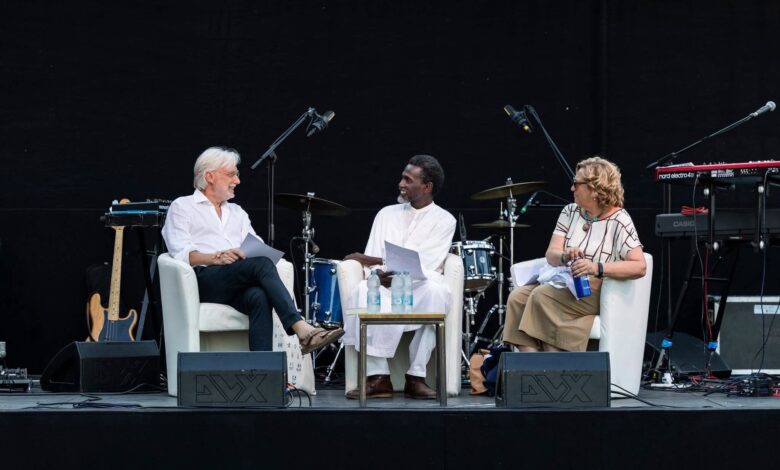
A second presentation followed after the celebration of the Casa della Poesia’s thirtieth anniversary, where Haidara shared the stage with Raffaella Marzano, paying tribute to an institution that has become one of Italy’s enduring homes for international poetry.
One photograph captured the spirit of the entire journey.
Taken by Sergio Iagulli inside the Casa della Poesia, it showed Haidara standing before the image of his dearly beloved friend, the Bosnian poet Izet Sarajlić. Across generations and beyond mortality, poets continued to accompany one another—not only through books, but through memory itself.
By the time the journey drew to its close, Italy had revealed itself as more than a destination.
It was a country where philosophers still converse through ancient institutions, where Epicurus still whispers from overlooking hills, where Virgil still receives prayers, where Dante still commands reverence, where Leopardi still teaches silence, and where poetry remains woven into everyday life with astonishing naturalness.
For Ismael Diadié Haidara, the voyage became something larger than literary travel.
It became a reminder that culture survives not only in museums and libraries, but in friendship, translation, gratitude, and the willingness of one civilization to welcome another.
And perhaps that is Italy’s greatest poem: a land where the past is never truly past, because every new traveler is invited to continue writing its eternal story.
The Broom Flower: A Living Memory of Leopardi
During his literary pilgrimage through Italy, Ismael Diadié Haidara paused before the tomb of Giacomo Leopardi, where the ginestra—the broom flower immortalized in the poet’s final masterpiece, La Ginestra (The Broom, or the Flower of the Desert)—still blooms on the slopes once shadowed by Vesuvius. Deeply moved by the encounter, Haidara placed one of these delicate blossoms inside his copy of Canti (Songs), preserving it as a cherished relic of the journey. More than a flower, it became a symbol of poetry’s enduring power to survive time, carrying the fragrance of memory from one poet to another across generations. Here is a short excerpt from the opening of La Ginestra:
“Here, upon the barren flank
of dread Vesuvius,
where neither tree nor blossom
dares to gladden the land,
you alone scatter your lonely shrubs,
fragrant broom,
content to dwell within the desert.”
Written by Dr. Ashraf Aboul-Yazid