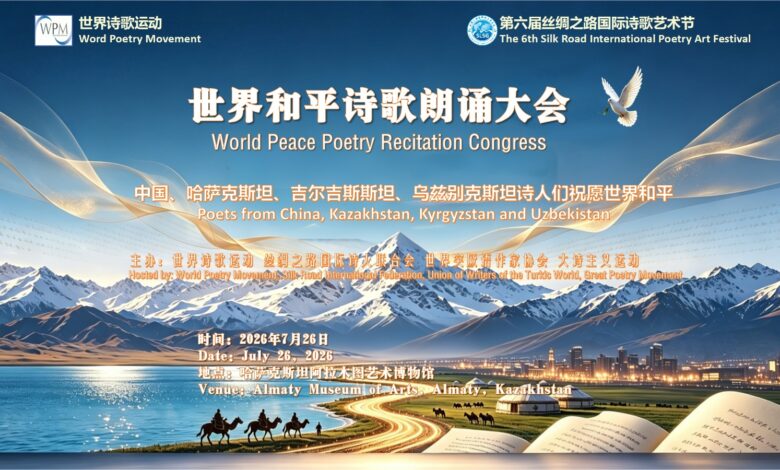
World Peace Poetry Recitation Congress to Convene in Kazakhstan
Almaty, Kazakhstan | July 2026
In a powerful affirmation of poetry’s role in promoting peace, intercultural dialogue, and mutual understanding, the World Peace Poetry Recitation Congress will take place on 26 July 2026 at the Almaty Art Museum in Kazakhstan. The international gathering responds to the July Peace Recital Initiative launched by the World Poetry Movement, bringing together poets from across Asia to celebrate the universal language of poetry as a force for harmony among nations.
The Congress will welcome one hundred poets representing China, Kazakhstan, Kyrgyzstan, and Uzbekistan, creating one of the most significant regional poetry gatherings of the year. Through multilingual readings and cultural exchange, participants will reaffirm poetry’s enduring mission of building bridges between peoples, preserving cultural diversity, and inspiring peaceful coexistence.
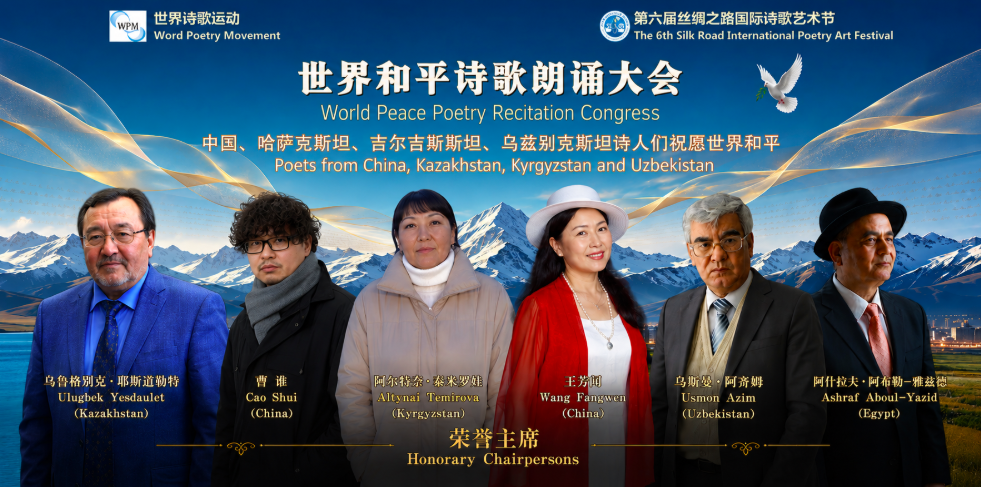
The event will be jointly hosted by six distinguished literary figures: Cao Shui (China), Wang Fangwen (China), Ulugbek Yesdaulet (Kazakhstan), Altynai Temirova (Kyrgyzstan), Usmon Azim (Uzbekistan), and Dr. Ashraf Aboul-Yazid (Egypt), whose participation reflects the international spirit of the initiative and the growing cooperation among literary communities along the Silk Road and beyond.
The Congress is organized through the collaborative efforts of the World Poetry Movement, the Silk Road International Poets Federation, the World Association (Union) of Turkic Writers, the Great Poetry Movement, and the BRICS Writers Association. Together, these organizations continue to promote poetry as a vehicle for cultural diplomacy, international friendship, and sustainable dialogue among civilizations.
Held in the cultural heart of Almaty, the World Peace Poetry Recitation Congress is expected to become a landmark event within the 6th Silk Road International Poetry Festival, highlighting the shared literary heritage of Eurasia while projecting a message of peace to the wider world. At a time marked by global challenges and divisions, the voices of one hundred poets reading for peace will stand as a compelling reminder that literature remains one of humanity’s most enduring instruments of hope, understanding, and reconciliation.