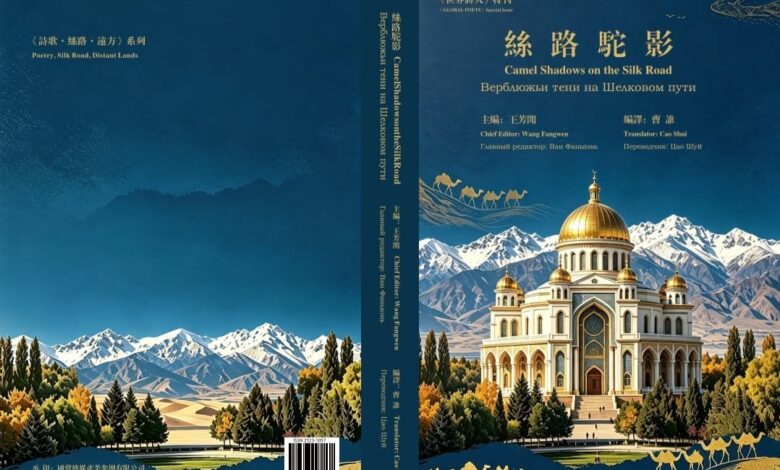
Global Poets Magazine Publishes Special Central Asia Edition: “Camel Shadows on the Silk Road”
100 poets from China , Central Asia and Egypt
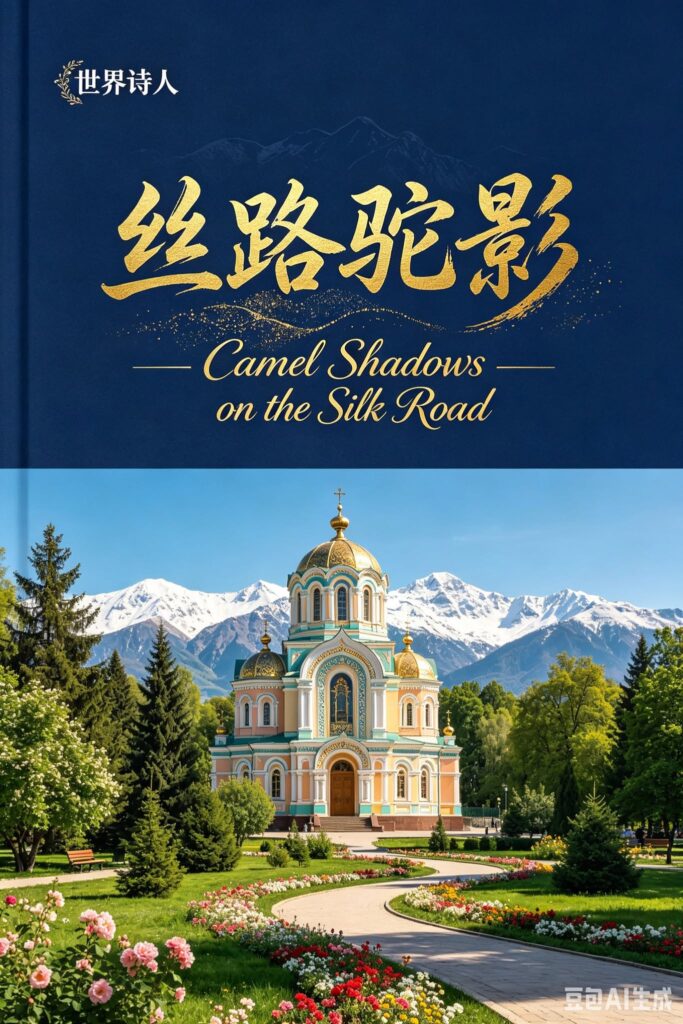
August 2026 — Global Poets Magazine has released a special edition dedicated to Central Asia under the evocative title “Camel Shadows on the Silk Road.” The issue brings together an anthology of works by 100 poets from China and Central Asia, presented in English translation, creating a literary space where the poetic traditions of the Silk Road meet contemporary voices from across the region.
The special edition is led by Editor-in-Chief Wang Fanwen, with Cao Shui and Sun Yi serving as Executive Editors-in-Chief. Cao Shui also undertook the translation of the anthology into English, helping carry the voices of Chinese and Central Asian poets beyond linguistic and geographical boundaries.
The opening section, “Camel Bells of the Silk Road,” establishes the historical and cultural spirit of the issue. It features reflections and speeches connected with the Silk Road and its enduring role as a meeting ground between civilizations. Among them are Ulugbek Yesdaulet of Kazakhstan, Wang Fanwen of China, Cao Shui of China, and Egyptian poet and writer Ashraf Aboul-Yazid, whose contribution, “The Spirit of the Silk Road on Papyrus,” connects the ancient heritage of the Silk Road with its continuing literary resonance. Kyrgyz poet Altynai Temirova contributes a reflection on the poetic dialogue extending from Li Bai to Abai.
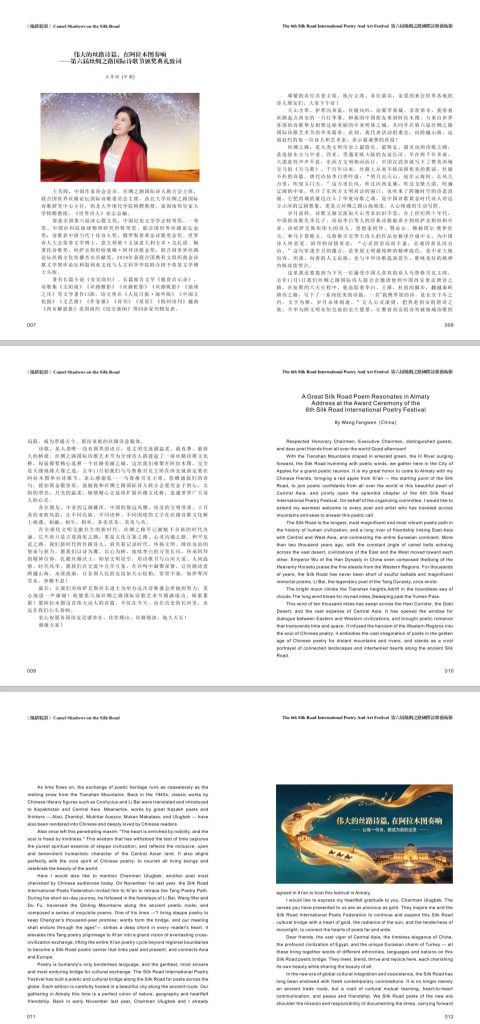
In her address, Wang Fangwen, President of the Silk Road International Poetry and Art Festival and Chairman of the International Poetry Committee of the UN World Silk Road Forum, stated that the Silk Road is the longest, most vibrant, and most enduring poetic road in the world, while poetry is the only language of humanity without borders and the gentlest, most sincere, and most enduring bridge for the exchange of civilizations.
She emphasized that the Silk Road International Poetry and Art Festival has always remained committed to its original aspiration of promoting mutual learning among civilizations, selecting a different historic Silk Road city to host the festival each year. Holding this year’s gathering in Almaty offers unique advantages in terms of geography, connectivity, and human relations.
Almaty stands at the crossroads of Eurasian and African civilizations and serves as a pivotal Silk Road city in Central Asia. Hosting a major poetry gathering here allows the vast and magnificent landscapes of Central Asia to meet and merge with the profound elegance and enduring heritage of Chinese civilization. It also creates a space where the literature and arts of different peoples, languages, and countries across Asia, Europe, and Africa can coexist, flourish, and enrich one another—truly realizing the Silk Road vision of “each culture displaying its own beauty, and all beauties flourishing together.”
In his address, Ulugbek Yesdaulet, former Chairman of the Writers’ Union of Kazakhstan, noted that the noble mission of the Silk Road International Poetry and Art Festival is to continue the tradition of civilizational dialogue that, for thousands of years, connected East and West and linked North and South, breathing new life into the ancient exchange of civilizations through contemporary literary creation.
In 1889, Rudyard Kipling wrote of the apparent divide between East and West. Decades later, in 1961, when humanity first reached into space, the great Kazakh poet Olzhas Suleimenov offered a different vision: “There is no East, and there is no West… There is one grand word—EARTH!”
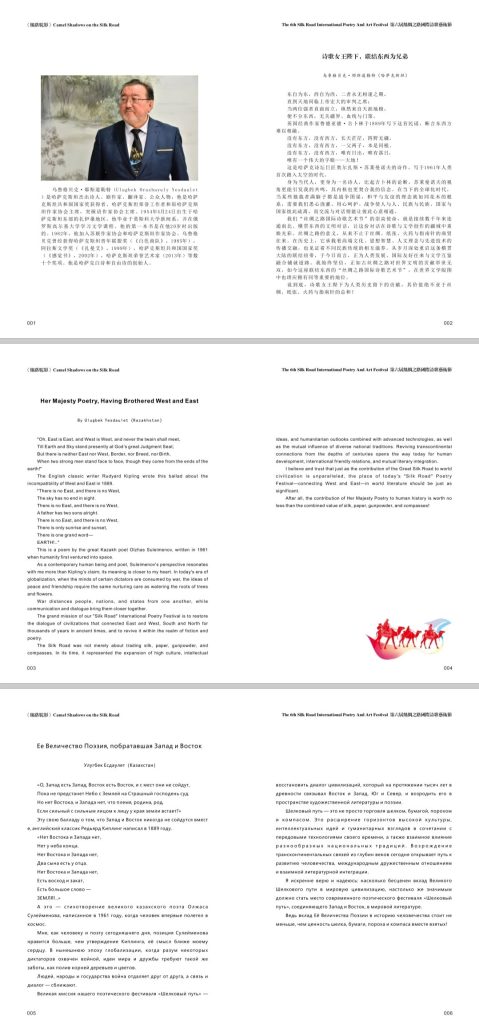
As a contemporary poet, I feel much closer to Suleimenov’s vision. In our globalized world, when war and division still occupy the minds of some leaders, peace and friendship need to be cultivated with the same patience and care with which we nurture trees and flowers.
War separates people, nations, and civilizations; dialogue, communication, and culture bring them together.
This is the essential mission of our Silk Road International Poetry Festival: to revive the dialogue among civilizations that once connected East and West, North and South along the ancient Silk Road, and to renew that dialogue through poetry and literature.
The Silk Road carried far more than silk, paper, gunpowder, and the compass. It transmitted knowledge, ideas, technologies, artistic traditions, and a spirit of human exchange across continents.
In his address, Cao Shui, Asian Coordinator of the Great Poetry Movement and Executive Chairman of the 6th Silk Road International Poetry Festival, reflected on the original vision behind the Silk Road as a poetic route. He recalled his 2019 literary journey through Kyrgyzstan, evoking the poetic spirit of
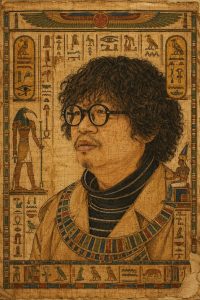
the flourishing Tang Dynasty through the ruins of Suyab and fragments of thousand-year-old pottery.
He proposed that the literature of a truly great nation should be a “Great Poetry” literature that unites humanity with nature, blends the ancient with the modern, and brings East and West together. It should inherit Li Bai’s expansive and all-embracing spirit, remain rooted in the earth while embracing the world, traverse the past and present, and connect East and West. In this way, the poetic spirit of China and that of the world can converge and resonate at the summit of the Silk Road and in the winds of the vast steppes, forging a shared spiritual resonance for all humanity.
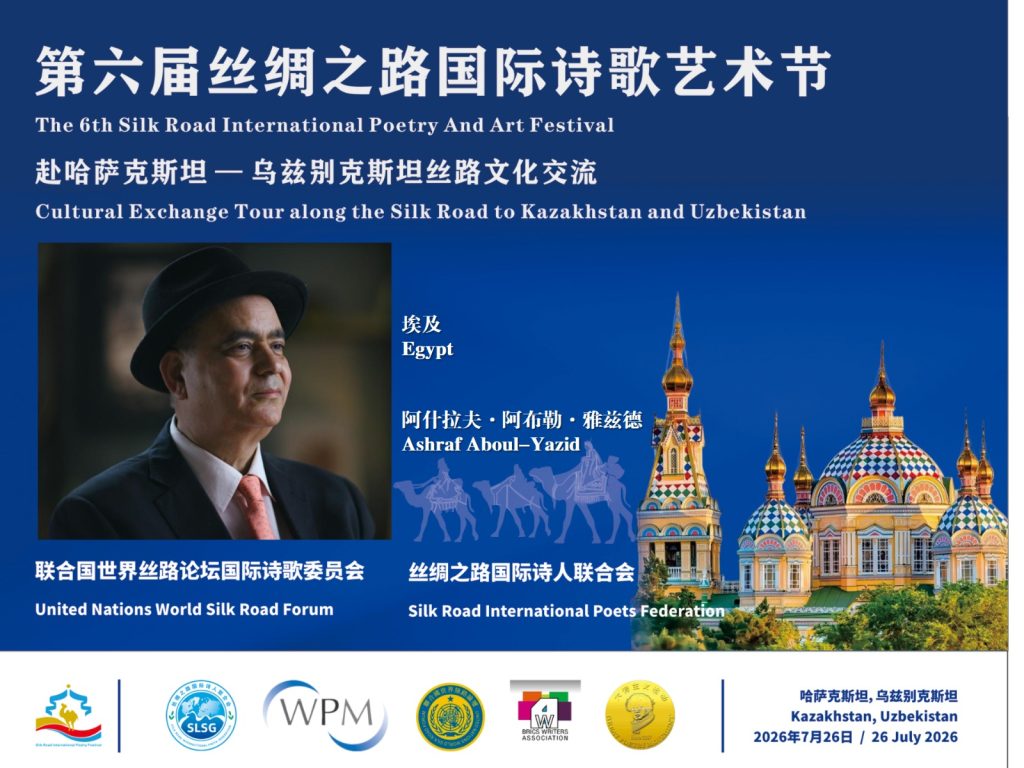
Speech by Dr. Ashraf Aboul-Yazid
“On Receiving the Medal of the Grand Poetry Movement, the Title of Laureate Poet of the Silk Road International Poetry Festival, and the Position of Honorary Chairman
Distinguished guests, esteemed poets, writers, and dear friends,
I receive these honors today with profound gratitude and deep humility. To be awarded the Medal of the Grand Poetry Movement, to be named a Laureate Poet of the Silk Road International Poetry Festival, and to serve as its Honorary Chairman is not merely a personal recognition; it is a celebration of the enduring power of literature to unite humanity.
I come to you from Egypt, a land where stories were first inscribed on papyrus, where words became monuments that outlived empires, and where the Nile has carried songs and wisdom across millennia. Every honor I receive belongs not only to me, but also to the countless poets, translators, artists, and cultural dreamers who believe that literature can build bridges where politics often builds walls.
Throughout my journey as a poet, novelist, journalist, translator, and traveler, I have discovered one fundamental truth: culture is our common homeland. The Silk Road has never been merely a route of commerce. It has always been a road of ideas, memories, languages, and human encounters. Along its ancient paths, civilizations learned to recognize themselves in one another.
For this reason, the Silk Road Literature project, which I founded a decade ago, was conceived as a contemporary continuation of that historic dialogue. Through translation, publishing, and cultural exchange, we have sought to bring literary voices from Asia, Africa, Europe, and Latin America into conversation with Arab readers and with one another. We have learned that every poem translated is a bridge built, and every book published is a door opened toward mutual understanding.
This evening, I wish to announce the launch of a new cultural distinction: The Golden Papyrus Award for Silk Road Literature.
This award is inspired by one of humanity’s earliest writing materials—the Egyptian papyrus. The Golden Papyrus symbolizes memory, wisdom, and the sacred act of preserving words across time. It also reflects the spirit of the Silk Road, where civilizations exchanged not only goods but also dreams, philosophies, and artistic visions.
The award will consist of a ceremonial box containing a Golden Papyrus inscribed with the name of each honoree, representing a timeless covenant between creativity and cultural dialogue.
It gives me immense pleasure to present the inaugural Golden Papyrus Awards to three remarkable personalities whose work has strengthened literary and cultural bridges among nations:
Poet Cao Shui, whose vision of the Grand Poetry Movement has created new spaces for global poetic dialogue;
Professor Wang Fangwen, whose intellectual and cultural contributions have fostered understanding between civilizations;
and Mr. Ulugbek Yesdaulet, distinguished poet, statesman, and cultural figure, whose lifelong service to literature and intercultural friendship embodies the spirit of the Silk Road itself.
Dear friends,
We live in an age of uncertainty, conflict, and rapid change. Yet poetry continues to remind us that human beings are capable of compassion, imagination, and hope. Literature does not erase our differences; rather, it transforms those differences into opportunities for discovery and friendship.
As Honorary Chairman of this festival, I accept this responsibility as an invitation to continue serving the international community of writers and artists. Let us keep opening new paths of cooperation. Let us translate more voices, share more stories, and create a future in which culture remains one of humanity’s most powerful instruments of peace.
Translating The Epic of Eurasia by Cao Shui was not merely a literary undertaking for me; it became an extension of my lifelong mission to build bridges among civilizations through translation and cultural dialogue. Through this monumental work, I sought to bring the voices, myths, and collective memory of Eurasia closer to Arab readers, reaffirming my belief that literature is the modern Silk Road that connects peoples beyond borders, languages, and histories.
I thank the organizers of this extraordinary event, and I thank every poet and reader present here. Above all, I thank the word itself—the humble word that travels farther than armies and lives longer than monuments.
May the Silk Road continue to be a road of poetry, friendship, and human understanding.
Thank you very much.”
Kyrgyz Poet Altynai Temirova Celebrates Poetry as a Bridge Between Civilizations at the 6th Silk Road International Poetry Festival. Her full speech is published in this link

The second section, “The Glory of the Laureates,” presents works by distinguished poets from Kyrgyzstan, Uzbekistan, Turkmenistan, Türkiye, Yakutia, Tajikistan, Azerbaijan, Armenia, Kazakhstan, and China. The selection demonstrates the remarkable geographical and linguistic diversity of contemporary poetry connected with the wider Silk Road cultural sphere, while highlighting recurring themes of homeland, love, history, identity, nature, memory, and human experience.
The third section, “The Radiance of the Golden Camel,” continues this poetic journey with works by poets from Kazakhstan, Kyrgyzstan, Uzbekistan, Yakutia, and China. Titles such as “Adagio,” “The Moon,” “Reflections on the Bridge,” “The Ancient Books on the Postal Road,” “The Thousand-Year Echo of Camel Bells,” and “Almaty — the Apple City on the Silk Road” evoke landscapes, memories, historical journeys, and the cultural imagination of Central Asia and China.
The magazine’s special edition is more than a collection of poems. It presents the Silk Road as a living literary and cultural space, where ancient routes continue to inspire contemporary dialogue. Through translation, poetry becomes a means of connecting different languages and traditions, allowing readers to encounter voices that might otherwise remain separated by geography and linguistic boundaries.
The inclusion of poets from China and the Central Asian republics, alongside voices from neighboring cultural spaces, reflects the magazine’s commitment to literary exchange, cultural dialogue, and the preservation of the shared heritage of the Silk Road. The anthology also demonstrates how contemporary poetry can transform historical memory into a living conversation about the present and the future.
With its 100-poet panorama and English-language presentation, “Camel Shadows on the Silk Road” offers international readers an opportunity to discover the richness of contemporary poetry emerging from one of the world’s most historically significant cultural corridors. It is a literary journey in which the echoes of ancient camel bells continue to resonate through the voices of today’s poets.
Global Poets Magazine Continues Its Silk Road Journey with Three New Sections of Poetry and Cultural Memory

The special Central Asia edition of Global Poets Magazine, “Camel Shadows on the Silk Road,” continues its literary journey in three further sections, expanding its panorama of contemporary poetry from Kazakhstan, Kyrgyzstan, Uzbekistan, China, and beyond. These sections deepen the magazine’s exploration of memory, landscape, identity, history, and the enduring cultural connections created along the ancient Silk Road.
IV. The Splendour of Poetic Chambers
Beginning on page 109, “The Splendour of Poetic Chambers” brings together a rich selection of poetic voices from Central Asia and China, with a contribution from Canada. The section opens with Dauletkerey Kapuly of Kazakhstan and continues with works by Erlan Zhunis and Erzhan Alashtugan, exploring images of rain, solitude, beauty, and the inner landscape of the human being.
Kyrgyz poetry is represented by Asan Zhakshylykov, Alymbaev Abdurakhman, and Altynbek Ismailov, whose works engage with questions of truth, inheritance, memory, and identity. From Uzbekistan come Sirojiddin Rauf, Gayrat Majid, and Shadi Atamurod, offering poems that explore love, human relationships, and the symbolic world of the camel and the Silk Road.
The Chinese contributions extend the geographical and historical scope of the section. Bai Miao, Hu Peiyuan, Dong Faliang, Zhang Qunli, Hong Sanhe, Wang Haoruo, and Xu Zunde bring together reflections on canals, confession, Yan’an, mountains, Dunhuang, Chang’an, and childhood. The Canadian-based poet Yuan Fan adds another international dimension with “Rain Hanging in the Sky.”
Together, these works create what the section’s title suggests: intimate poetic chambers in which individual experience opens onto wider cultural landscapes.
V. Poetry and Images
The fifth section, “Poetry and Images,” begins on page 143 and offers a more concentrated collection of poems inspired by powerful visual and geographical symbols. Chen Donglin presents “The Smiling Buddhist Statue of Bamiyan,” connecting poetry with the cultural memory of Afghanistan and its monumental heritage.
Chen Hong turns to “The Camel Bells of Samarkand,” directly invoking one of the most recognizable symbols of the Silk Road. Sun Meiqin brings Taipei into dialogue with the Silk Road through “Drunk with Taipei at a Ski Resort on the Silk Road,” while Shen Gongli and Pan Dongfeng explore the poetic energy of Lantian and the evocative landscapes of Malacca through “The Wind and Moon of Malacca.”
This section demonstrates how poetry transforms places into images and images into cultural memory. From Bamiyan and Samarkand to Lantian, Taipei, and Malacca, the poems reveal the Silk Road not simply as an ancient route, but as a continuing imaginative geography.
VI. The Poetic Formation
The sixth section, “The Poetic Formation,” begins on page 153 and brings together another broad constellation of voices from Kazakhstan, Kyrgyzstan, Uzbekistan, and China. The section opens with Arailym Muratalieva of Kazakhstan, followed by works by Batyrkhan Sarsenkhan and Duisenali Alimakin, whose poems explore beauty, cultural identity, books, and the intimate relationship between people and place.
Kyrgyzstan is represented by Kanybek Imanaliev, Ormotova Altynai, and Eldar Atokurov, whose works move between memories of the village, distant places, and symbolic images such as the golden peach. Uzbek poets Nargiza Asadova, Qutlibeka Rakhimbaeva, and Salim Ashur contribute poems addressing love, sudden moments of revelation, and the delicate fragility of human experience.
The Chinese section introduces Ding Peisheng, Sun Jinping, Huang Shaobin, Wang Huilian, Ma Shiqi, and Ren Tianyi. Their works range from the figure of a building keeper and contemporary poetry to childhood songs, memories of wells, the enduring image of Chang’an, and reflections on the Silk Road itself.
The closing contribution, “The Silk Road Carries Rhyme, Elegance Spreads Across the World,” by Ren Tianyi, is particularly appropriate as a poetic statement of the entire special issue. It encapsulates the magazine’s central vision: that poetry can carry cultural memory across borders, allowing languages, histories, and civilizations to encounter one another through artistic expression.
With these three sections, Global Poets Magazine further establishes “Camel Shadows on the Silk Road” as an ambitious international anthology in which contemporary poetry becomes a vehicle for cultural exchange. The voices gathered here demonstrate that the Silk Road continues to live—not only in archaeological sites, ancient manuscripts, cities, and landscapes, but also in the imagination of today’s poets.
Through translation and publication, these poets are brought into conversation with readers around the world, reaffirming poetry’s unique ability to cross linguistic and political boundaries and to transform the shared heritage of the Silk Road into a living dialogue between cultures.
Global Poets Magazine Concludes Its Special Central Asia Edition with a Celebration of Poetry, Calligraphy, and the Living Spirit of the Silk Road
The final part of the special Central Asia edition of Global Poets Magazine, “Camel Shadows on the Silk Road,” brings the publication to a rich and reflective conclusion. The final sections move from classical poetic forms and calligraphy to critical studies of Silk Road poetry, literary encounters between East and West, and highlights from the International Silk Road Poetry and Art Festival. Together, they reinforce the magazine’s central vision of the Silk Road as a continuing cultural and poetic journey.
VII. Calligraphy and Scrolls
Beginning on page 183, “Calligraphy and Scrolls” presents a selection of Chinese poetry that evokes the visual and literary traditions of the classical Chinese scroll. The section opens with Mu Xiaoping’s “Conversation About Spring,” followed by selected poems by Lei Tao and Hou Zhenyu’s “Song of the Silk Road.”
The section continues with Tian Jiguang’s “Flying Sea” and Li Yanqiu’s regulated seven-character poem, “Ascending Qingling Mountain.” Through these works, poetry is presented in close relationship with the long tradition of Chinese calligraphy, where the written word is simultaneously literature, visual art, rhythm, and cultural memory.
The combination of poetry and scroll imagery also reflects one of the defining characteristics of the Silk Road tradition: the movement of artistic forms across civilizations and generations.
VIII. Songs of the Silk Road
The eighth section, “Songs of the Silk Road,” beginning on page 193, shifts from individual poems to broader reflections on the cultural and philosophical significance of Silk Road poetry.
Wang Fanwen’s “Aesthetic Creation and Cultural Value of Silk Road Poetry in the Tianshan Corridor” examines the poetic and cultural dimensions of the Silk Road corridor, presenting poetry as an important form through which landscapes, civilizations, and historical memories continue to communicate.
Russian writer Vadim Trukhin, in “Camel Bells Through Time: Listening to the Echo of Existence Between East and West,” explores the enduring dialogue between Eastern and Western civilizations through the metaphor of the camel bells that have accompanied travelers across the Silk Road.
From the United Arab Emirates, Adel Shahmir contributes “The Poetry of Wang Fanwen: An Existential Journey of the Silk Road,” offering a literary reading of Wang Fanwen’s poetic vision. The section concludes with Chen Donglin’s “The Silk Road — The Longest Poetry Road in the World,” an evocative formulation that captures the central philosophy of the entire special issue.
IX. Listening to the Golden Voice
The ninth section, “Listening to the Golden Voice,” begins on page 219 and brings together four works connecting poetry with historical memory, geography, and the legendary figures of the Silk Road.

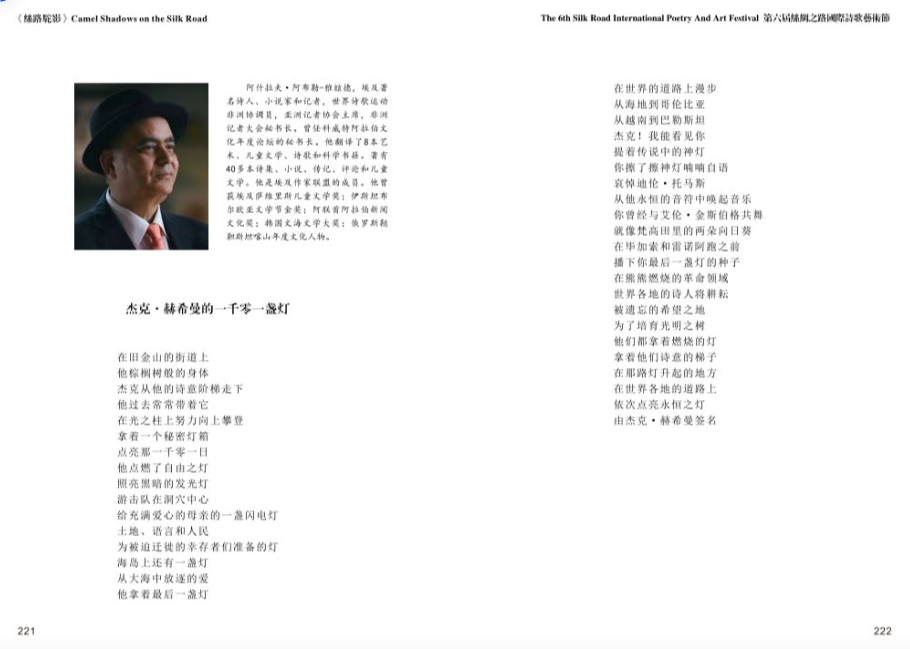
Kazakh poet Ulugbek Yesdaulet contributes “Pastoral Poetry,” while Egyptian poet Ashraf Aboul-Yazid presents “One Thousand and One Lamps of Jahrman,” adding an Egyptian voice to this international poetic dialogue.
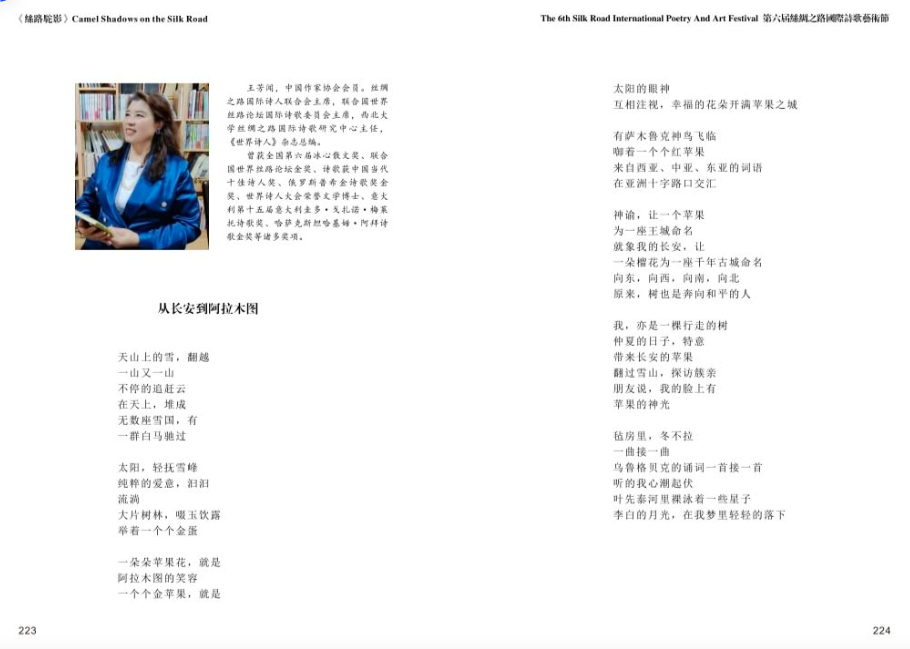
Wang Fanwen’s “From Chang’an to Almaty” traces a poetic route between two emblematic Silk Road cities, while Cao Bai’s “Li Bai, Gazing at the City of Suyab Like Iron” returns to the celebrated Chinese poet Li Bai and the historical landscapes associated with his legacy.
This section once again demonstrates how geography becomes poetry: cities, mountains, roads, and historical figures are transformed into symbols of a shared cultural memory.
X. Evaluation of Calligraphy and Painting
Beginning on page 227, “Evaluation of Calligraphy and Painting” presents the assessment of calligraphic and artistic works associated with the International Silk Road Poetry and Art Festival.
This section expands the magazine beyond the written poem, emphasizing the close relationship between poetry, painting, and calligraphy in the artistic traditions represented throughout the Silk Road. It also reflects the festival’s broader commitment to bringing different forms of artistic expression into a common cultural space.
XI. Highlights of the International Silk Road Poetry Festival
The final section, “Highlights of the International Silk Road Poetry Festival,” begins on page 235 and provides a documentary and literary record of important activities connected with the festival.
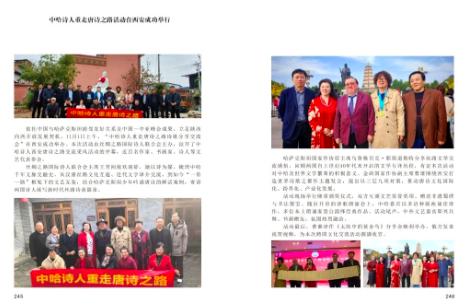
Kang Tao’s “Chinese Traces in the Desert” opens the section, followed by a report on the successful Xi’an event “Chinese Poets Walk the Poetry Road of the Tang Dynasty,” which reconnects contemporary poets with the literary heritage of one of China’s most influential historical periods.
The section also includes the Organizing Committee of the International Silk Road Poetry and Art Festival, documenting the institutional framework behind this international cultural gathering.
The issue concludes with Ulugbek Yesdaulet’s “Dedicated to Wang Fanwen, Queen of Silk Road Poetry.” This final tribute provides an especially fitting ending to the volume, bringing together admiration for an individual poet with the larger idea of poetry as a force capable of connecting peoples, cultures, and generations.
A Literary Journey Across the Silk Road
With these final sections, Global Poets Magazine: “Camel Shadows on the Silk Road” completes an ambitious literary journey linking China and Central Asia through poetry, translation, criticism, calligraphy, painting, and cultural exchange.
The magazine does more than present an anthology of contemporary poets. Across its eleven sections, it constructs a literary map in which ancient cities such as Chang’an, Samarkand, and Almaty, historical figures such as Li Bai, and contemporary poets from across Asia and beyond become interconnected through a shared cultural imagination.
The final pages also underline the importance of international literary festivals as living spaces for dialogue. By documenting poetry readings, artistic encounters, critical reflections, and cultural activities, the publication preserves not only individual poems but also the relationships and encounters that give the Silk Road its continuing meaning.

“Camel Shadows on the Silk Road” therefore closes not with an ending, but with an invitation: to continue listening to the voices carried along this ancient route, where poetry remains a powerful language of memory, friendship, cultural understanding, and human connection.