Bridging Worlds: Culture, Resilience, and the Power of Human Connection in a Transforming Era
CAJ International Magazine, April 2026 Edition
Sunday April 5th, 2026
In this April 2026 issue of CAJ International Magazine, we find ourselves navigating a rich confluence of memory, movement, and meaning—where literature, journalism, heritage, and innovation intersect across continents. This edition is not merely a collection of stories; it is a cartography of human experience, drawn through translation, resilience, and creative vision.
CAJ International Magazine, April 2026 Edition
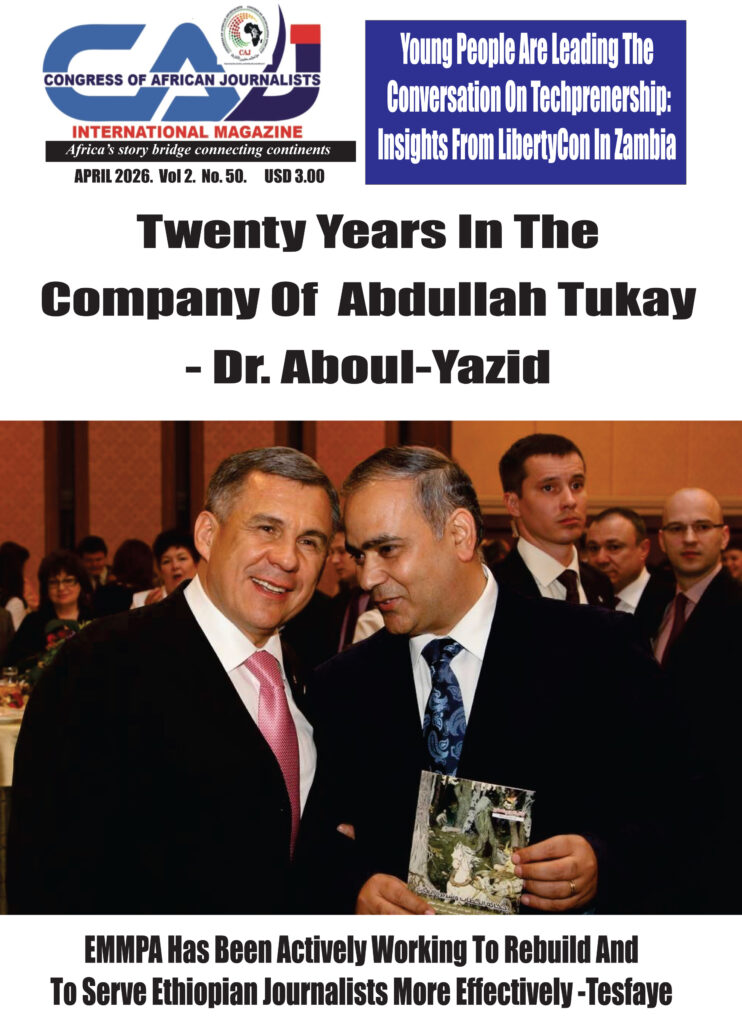
At the heart of this issue stands our cover story by CAJ Secretary General, Dr. Ashraf Aboul-Yazid, whose twenty-year journey of travel, reading, and translation culminates in a symbolic cultural encounter with Rustam Minnikhanov, President of Tatarstan. Their meeting celebrates the Arabic translation of Shuraleh, the folkloric poetic masterpiece by the iconic Tatar poet Abdullah Tukay. This story transcends literary effort; it is a testament to patience, devotion, and the enduring power of translation as a bridge between civilizations. In an era often marked by fragmentation, such work reminds us that language remains one of humanity’s most profound tools of unity.
This theme of cultural continuity resonates strongly in Nasir Aijaz’s exploration of The Al-Sindi Legacy, where history unfolds not as a static past but as a living current. For centuries, the Indus and the Arab world have been linked through trade, migration, and shared identity. The name “Al-Sindi” stands today as a symbol of this enduring exchange—proof that identity is not confined by geography, but enriched through movement.
Yet, alongside heritage, this issue confronts the pressing realities of our time. In Ethiopia, as Tiblet Tesfaye Dejene reveals, journalism remains a field of courage and complexity. Despite systemic challenges, a new generation of journalists continues to uphold the values of truth and public service, supported by initiatives aimed at safeguarding press freedom and professional dignity.
Across the continent in Zambia, LibertyCon Africa 2026 offers a different narrative—one of bold beginnings. Here, young Africans are not waiting for opportunity; they are creating it. Techpreneurship emerges as both a mindset and a movement, reshaping economies and redefining agency. This spirit of innovation is echoed in Nigeria’s clean cooking revolution, where the transition to sustainable energy is not only improving health outcomes but also redefining domestic life, particularly for women who have long carried the burden of traditional cooking methods.
Indeed, the question of empowerment extends further into agriculture, where closing the gender gap remains critical to Africa’s sustainable future. As Dela Ahiawor argues, achieving the 2030 development goals depends on recognizing and investing in the vital role of women farmers across the continent.
Meanwhile, culture continues to thrive as a space of dialogue and resistance. The African Book Fair in Paris gathers voices from across the globe, celebrating youth and literary exchange, while in Cairo, Abdel Razek Okasha’s monumental mural transforms the tragedy of Gaza into a visual epic—an artistic cry that echoes Picasso’s Guernica, reminding us that art remains a witness to history’s deepest wounds.
From literature that reclaims marginalized voices to nations that redefine resilience in times of crisis, this issue captures a world in motion—complex, interconnected, and alive with possibility.
In these pages, we are reminded that while our stories may begin in different places, they inevitably converge in the shared pursuit of meaning, dignity, and hope.